

In today’s digital world, the amount of content being produced is mind-boggling. Every minute, millions of social media posts are uploaded, thousands of videos are streamed, and thousands of ads are vying for a mere split second of our attention. In this noisy world, companies feel the need to “scream” louder—shelling out enormous amounts of money on flashy ads and viral marketing stunts.
But there is a quiet power at work in the background that offers far more stability, credibility, and growth than any viral marketing trend could ever hope to: Search Engine Optimization (SEO).
SEO is the art and science of being discovered when it matters most. It’s not about shouting at the crowd; it’s about whispering the right answer into the ear of someone who is already asking the question.
1. The Psychology of the Search: Intent vs. Interruption
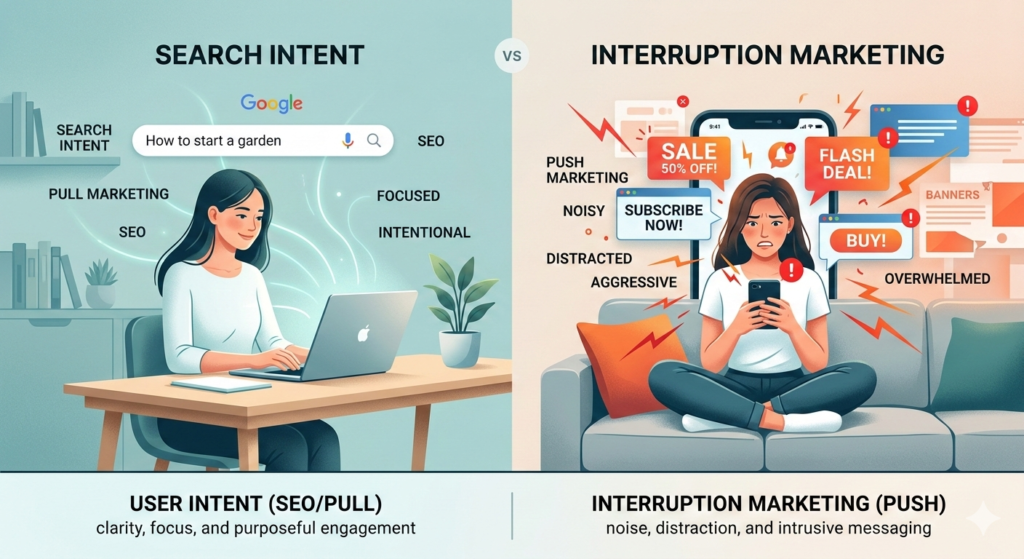
- To grasp the power of SEO, we need to examine the differences between SEO and traditional forms of advertising. The majority of online marketing is Interruption Marketing. You are watching a YouTube video, and an advertisement interrupts you. You are browsing Instagram, and an ad interrupts your flow.
- SEO is Inbound Marketing. It is driven by Intent. When a user searches on Google, they have a need, a question, or a desire. They are looking for an answer.
- When you show up at the top of the search engine results page, you are not an interruption; you are a solution.
- This is the psychological difference between “selling” and “solving,” which is why organic search traffic so often converts at a much higher rate than paid social traffic.
2. Creating an Invisible Fortress: Trust and Credibility
The “Quiet Power” of SEO in today’s digital world is that it all happens beneath the radar of conscious human trust. Google has spent decades conditioning us to trust that the top organic listings are the most credible.
Paid Ads (PPC): These are easily recognizable as “advertising” and are thus seen as “bought” results. They are great for a quick fix, but they do not necessarily instill long-term brand credibility.
Organic Listings: To be listed here means that your content has passed muster with the world’s greatest algorithm and has been determined to be the best answer to a question.
By appearing in the search results for relevant keywords, a brand establishes Institutional Authority. You become the “go-to” source for your industry without ever having to point to it and say, “Hey, look at me, I’m an authority!”
3. The Compounding Interest of Digital Marketing
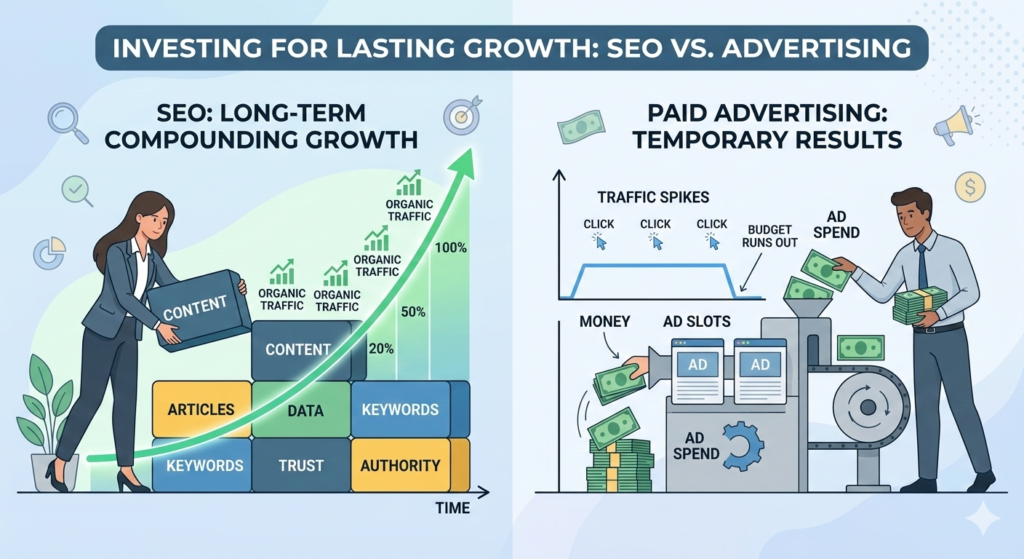
The biggest mistake that companies make in today’s digital world is that they consider SEO a one-time thing. The truth is that SEO is an investment that has a compounding interest rate. Ads (Linear Growth): You spend $1,000, and you get X amount of traffic. When you stop spending money, the traffic stops. SEO (Exponential Growth): You invest in quality content today. It begins to rank in three months. A year later, that same piece of content is still bringing in thousands of visitors for free. While your competitors are on the “hamster wheel” of increasing ad costs (CAC) in the digital world, your solid SEO foundation enables you to decrease your customer acquisition costs over time. The quiet work you do today builds lasting authority in the ever-evolving digital world and continues to pay off for years to come.
4. The Modern Foundations of Successful SEO
SEO has come a long way from “keyword stuffing.” In today’s dynamic digital world, to successfully leverage SEO, one must understand and excel at four foundational areas:
A. E-E-A-T (Experience, Expertise, Authoritativeness, and Trustworthiness)
The four areas are highlighted in Google’s search quality evaluator guidelines. To rank high, your content must demonstrate that you are not simply writing for search engines but have actual experience and expertise in your field of interest.
B. Technical Mastery
The “quiet” side of SEO is often where technical expertise comes into play. A website must be:
Fast: Speed is a direct ranking factor.
Mobile-First: Most searches occur on mobile devices. If your site is not mobile-friendly, you are invisible to mobile users.
Secure: HTTPS is no longer optional.
C. The User Experience (UX)
Google tracks “Dwell Time” and “Bounce Rate.” If users click on your link and immediately return to the search engine, Google knows that your content did not answer their query. Successful SEO today means successful web design and valuable content.
D. Strategic Backlinking
Imagine a backlink as a “vote of confidence” from another website in the digital world.. When authoritative websites link to your website, they are essentially telling Google, “This source is legitimate.” This is a slow and quiet process, but it is the foundation of search engine domination.
5. SEO as a Barrier to Entry
In a noisy world, a high ranking is a competitive barrier. If you own the top three positions for the most valuable keywords in your niche, you have essentially built a fortress.
New entrants can enter the market with a bigger ad budget, but they cannot buy the years of “domain authority” and the thousands of organic backlinks you have built. This makes SEO one of the most effective ways to protect your market share in the long run.
6. Adapting to the Future: AI and Voice Search
The digital world is getting even noisier with the advent of AI (such as ChatGPT and Gemini) and Voice Search (Alexa and Siri). SEO is adapting to these changes through Natural Language Processing (NLP).
People don’t just type “Pizza Kochi” anymore; they ask, “Where is the best place to get sourdough pizza near me?” SEO helps you capture these conversational searches. By optimizing for the way people actually speak, you stay ahead of the curve while others are still optimized for 2015.
7. The Synergy: SEO and Brand Awareness
Although SEO is considered a form of “performance marketing,” it is actually a covert branding operation.
Even if the user doesn’t click on your link the first time, the fact that your name is at the top of the search results page for five different searches establishes Brand Salience. When they are finally ready to buy, your name is the first one that pops into their head. This is the “Quiet Power” at work—shaping perception without the user even knowing it.
8. The Lifecycle of a Keyword: Beyond Basic Search
- To grasp the “Quiet Power,” it is essential to examine the lifecycle of a keyword in today ‘s digital world. In a noisy world, generic keywords such as “Shoes” are simply too noisy and competitive. The strength is in the Long-Tail Keyword.
- The Discovery Phase: Consumers begin with broad, “noisy” keywords.
- The Consideration Phase: As they progress through the sales funnel, their searches become more specific (for example, “best waterproof running shoes for flat feet”).
- The Conversion Phase: This is where SEO triumphs. By focusing on extremely specific, low-traffic, high-conversion keywords, a brand can avoid the “noise” of the overall market and communicate directly with a consumer about to make a purchase. This is the Blue Ocean Strategy in SEO—identifying areas where the competition is thin but the intent is thick.